The Quiet Revolution
Nuclear medicine sees what other scans can't — and increasingly treats what it finds. Two of India's leading specialists explain PET-CT, theranostics and the brain scans changing how we diagnose cancer, heart disease and dementia.
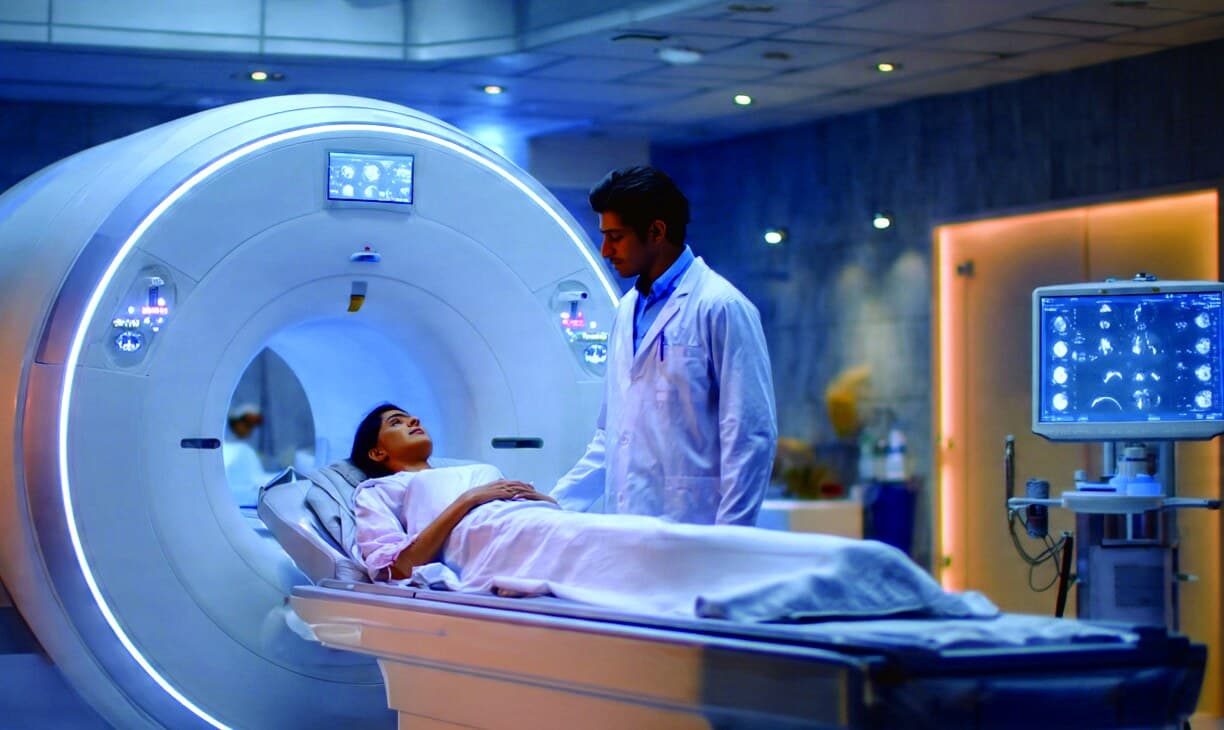
It sounds like science fiction — injecting radioactivity into a patient to diagnose or treat disease. But nuclear medicine is one of the quietest, most elegant revolutions in modern healthcare, and chances are you or someone you love will encounter it.
Mrs. Kulkarni had been "just tired" for three months. Her blood tests, ultrasound, and CT scan all came back unremarkable. Then someone suggested a PET-CT. About sixty minutes after a simple injection, a radioactive tracer — chemically disguised as sugar — drifted through her bloodstream. Cancer cells are gluttons for sugar, and wherever they were hiding, they lit up like windows in a city seen at night.
The scan found the known thyroid nodule, a lymph node no one had felt, and a third, smaller spot near her collarbone, invisible on CT. Nuclear medicine doesn't ask what does this look like; it asks what is this actually doing. Weeks later, after surgery and a single capsule of radioactive iodine, her thyroid tissue and any stray cancer cells were gone — quietly, precisely, from the inside. It isn't about more radiation; it's smarter radiation: the same molecule doing two jobs, find it, then finish it.
First, let's kill the fear factor
The word "nuclear" conjures reactors and radiation leaks — misleading here. Patients receive a tiny, carefully calculated radiopharmaceutical, usually by injection or capsule. Unlike radiotherapy, which aims radiation at you from outside, nuclear medicine works from within, attached to a molecule that knows exactly where to go.
Part one: the detective work
X-rays show you the map; nuclear medicine shows you the traffic. A CT or MRI shows structure but not always whether it's working normally. A radiotracer follows a biological pathway — sugar metabolism, bone turnover, blood flow — while a PET or SPECT camera tracks where it accumulates, producing a picture of function rather than anatomy.
| Scan | What it shows |
|---|---|
| PET-CT | The whole-body cancer detector, lights up cancer cells long before a lump might be felt. |
| Bone scan | Detects cancer's spread to bone, or a hidden stress fracture, weeks before an X-ray would show anything. |
| Thyroid scan | Reveals whether the gland is overactive, underactive, or hiding a nodule. |
| Heart scan (MPI) | Shows whether blood reaches the heart muscle under stress, catching blockages before a heart attack. |
| Renal scan | Shows how each kidney functions and drains, often gatekeeping surgery. |
Finding, though, is only half the story.
Part two: the precision strike
Nuclear medicine doesn't just diagnose — it treats, with a precision chemotherapy or radiotherapy can't always match. This is theranostics: the molecule that finds disease is re-engineered with a radioactive particle and sent back in to destroy it — exactly what happened, in miniature, inside Mrs. Kulkarni's body.
| Therapy | What it does |
|---|---|
| Radioactive iodine | For thyroid disease — the original theranostic success, used safely for over seventy years. |
| Lutetium-177 PSMA therapy | For advanced prostate cancer resistant to hormone treatment: a PET scan confirms the tumour's molecular address, then a drip delivers radiation over a very short distance. |
| PRRT (Peptide Receptor Radionuclide Therapy) | A lock-and-key treatment for neuroendocrine tumours resistant to standard chemotherapy. |
| Radium-223 | Mimics calcium to travel straight to cancer-affected bone. |
“This isn't a sledgehammer. It's a scalpel that travels through the bloodstream and finds its own target.”
A new window into dementia
When Mr. Banerjee began repeating questions and got lost on a familiar route, his family wondered: stress, or the start of Alzheimer's? An MRI can rule out a stroke or tumour but may not explain fading memory. Nuclear medicine looks deeper, at the brain's activity and, sometimes, the proteins building up inside it.
The FDG PET brain scan shows how the brain uses sugar; in Alzheimer's, memory-related areas may use less energy in a recognisable pattern, sometimes before structural scans show anything. The amyloid PET scan looks for plaques linked to Alzheimer's — a negative scan makes the disease much less likely, while a positive one is read alongside symptoms and memory testing. Newer scans can also detect tau, though availability varies.
None of these is a crystal ball, and amyloid can appear in people who never develop dementia. But for a family living with uncertainty, a clearer answer is invaluable — helping distinguish Alzheimer's from other causes of decline, aiding diagnosis of Parkinson's, and guiding treatment planning.
Why this should matter to you
You may never personally need nuclear medicine. But if a loved one is told "let's do a PET scan" or "we're going to try a targeted radioactive therapy," you'll know this isn't fringe science — it's one of the most sophisticated branches of modern medicine, built on a simple idea: if you can see disease precisely, you can treat it precisely. Nuclear medicine, quiet and often unsung, has been rehearsing for this future for seventy years. It's just now stepping into the spotlight.
Five things people get wrong about nuclear medicine
Am I radioactive after this?
Almost never a concern — diagnostic doses are tiny and clear the body within hours.
Isn't this the same as radiotherapy?
No. Radiotherapy aims a beam at you from outside; nuclear medicine sends a molecule inside that finds its own destination.
This sounds experimental.
Radioactive iodine for thyroid disease has been used safely since the 1940s.
CT, MRI, PET — what's the difference?
CT and MRI show structure; nuclear medicine shows function.
Isn't this dangerous for staff and the environment?
Nuclear medicine departments are among the most tightly regulated spaces in any hospital.
The quiet revolution does not stand still. The Association of Nuclear Medicine Physicians of India (ANMPI) will bring clinicians and researchers together at its 24th national conference (ANMPICON 26) in Kolkata to examine the technologies and trends shaping what comes next — from smarter imaging and theranostics to more personalised care.