The Shah Doctrine
For over a decade, Amit Shah has operated at the nerve centre of Indian politics — quietly building, recalibrating, and expanding power. This is the story of the man behind the machine.

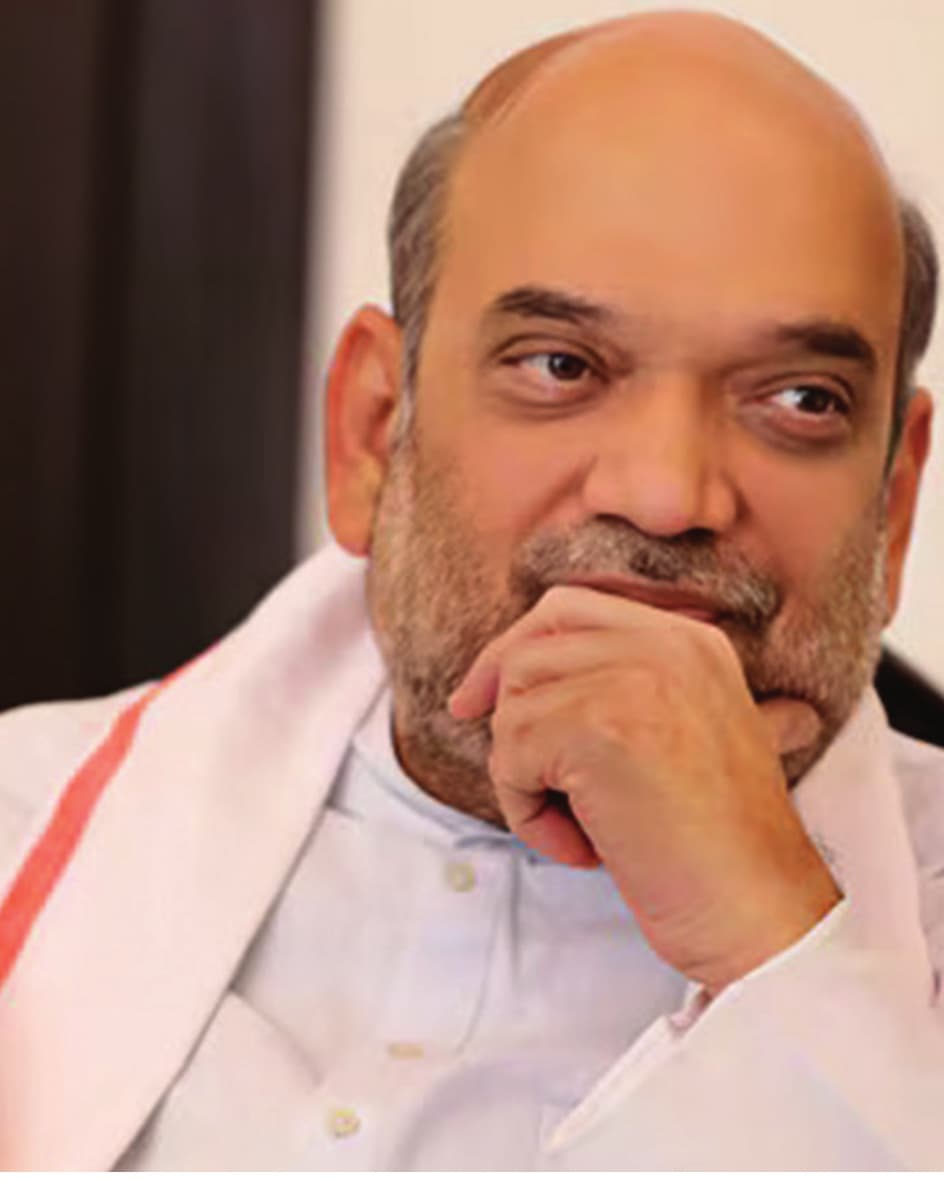
In the long, winding theatre of Indian politics — where reputations are built over decades and demolished in a single news cycle — there is one figure who, over the last twelve years, has refused to flicker. Amit Shah is not merely a politician. He is, increasingly, the operating system on which the Bharatiya Janata Party — and arguably the Indian Republic in its present form — runs.
To call him the Chanakya of our times has become almost lazy shorthand. And yet, no other description quite fits. I have spent close to three decades watching this country’s politics from far too close a distance — prime ministers come and go, party presidents are anointed and forgotten, kingmakers are crowned and quietly retired. But I must confess: I have never quite seen anyone like Amit Bhai.
“For over a decade, Amit Shah has operated at the nerve centre of Indian politics — quietly building, recalibrating, and expanding power.”
The long apprenticeship
To understand the man, one must first understand where he came from. West Bengal may have happened now, but there was Uttar Pradesh in 2014 — when the BJP won 71 out of 80 Lok Sabha seats, a feat that helped the party come to power at the Centre on its own.
So how did Amit Bhai become the Shah of Indian politics?
His journey did not begin in the air-conditioned drawing rooms of Lutyens’ Delhi. It began in the bylanes of Naranpura in Ahmedabad, where, as a teenager in the late 1970s, he was already running errands for the Rashtriya Swayamsevak Sangh. His was no meteoric rise. It was a long, almost monastic apprenticeship in the trenches of organisational politics — booth committees, ward-level meetings, electoral rolls annotated by hand in dimly lit party offices.
For years, he was the man behind the man. In the late 1980s and 1990s, the BJP’s principal flag bearer was another Gujarati — L.K. Advani, then the Member of Parliament from Gandhinagar. One of Advani’s key aides was Narendra Modi, who would later become Chief Minister of Gujarat. Amit Shah was Modi’s protégé — his trusted lieutenant. In that sense, Shah was two circles removed from the innermost core of Gujarat BJP politics in those days.
It was during the period when the BJP was transforming Gujarat into its ideological laboratory that Shah came to Modi’s notice. The journey was neither smooth nor easy. As Modi rose to become Chief Minister, Shah emerged as his number two — the crisis manager, the man Modi could rely on in moments of political exigency.
Between 2009 and 2012, Shah faced a litany of charges during the UPA era, largely due to his proximity to Modi. But he never wavered. In recent interviews, he has often remarked that, unlike others placed in similar circumstances, he never questioned the legitimacy of Indian institutions. Ultimately, the relief he received came from the very courts and agencies that he believed had once been misused against him.
2014: the gambit that changed everything
In 2013, when Modi was anointed as the BJP’s prime ministerial candidate, the conventional wisdom in Delhi was simple: the road to 7 Race Course Road (now Lok Kalyan Marg) ran through Uttar Pradesh — and for the BJP, that road appeared to be a cul-de-sac.
The party had not formed a government on its own in Lucknow for over two decades. The Samajwadi Party and the Bahujan Samaj Party had carved up the state’s caste arithmetic with surgical precision, leaving little apparent space for the BJP.
Modi sent Shah. What followed was nothing short of a political earthquake.
Shah did what no strategist had attempted in Uttar Pradesh. He moved beyond the BJP’s traditional upper-caste base and constructed a new electoral coalition — non-Yadav OBCs, non-Jatav Dalits, and the most backward communities — bound together by a sharply defined Hindutva narrative. The result: 71 out of 80 Lok Sabha seats. The BJP’s vote share in the state nearly doubled. It was, quite simply, the single largest contribution to Modi’s first majority government.
If 2014 was the gambit, 2017 was the proof of concept. In the Uttar Pradesh Assembly elections, the BJP won 312 out of 403 seats — a sweep so overwhelming that even seasoned party veterans struggled to comprehend it. By 2019, the question was no longer whether the BJP would win, but by what margin. The panna pramukh system — where a party worker is responsible for a small set of voters — had evolved into a self-sustaining organisational machine. The BJP returned to power with 303 seats. Modi was the face; Shah was the engine room.
The guru and the shishya
Much has been written about the Modi–Shah relationship, and most of it misses the essential point. This is neither a partnership of equals nor a relationship of subordination. It is, in the truest Indian sense, a guru–shishya parampara.
Modi identified Shah’s potential in the early 1980s, when both were associated with the RSS in Gujarat. Modi was the mentor — the one who recognised in the young, intensely organisation-driven Shah a rare political instinct. Over four decades, their relationship has been built on absolute, almost spiritual trust. Modi sets the vision. Shah executes it. Modi speaks to the nation. Shah speaks to the booth. They are, in many ways, two halves of the same political organism.
I am often asked whether Shah will one day overshadow Modi. The question fundamentally misreads the relationship. Shah has never sought to overshadow his mentor; he has sought to ensure that the mentor’s mission — and the broader ideological project — does not falter. That, perhaps, is both his greatest political insurance and his deepest source of legitimacy within the parivar.
From strategist to statecraft
When Shah took charge of the Home Ministry in 2019, sceptics wondered whether a master strategist could also become a master administrator. Six and a half years later, that question appears largely settled.
Article 370 was abrogated in a single, audacious legislative move. The Citizenship Amendment Act was passed despite prolonged protests. Colonial-era criminal laws were overhauled. And perhaps most significantly, the Naxal corridor — once a sprawling insurgent belt across central India — has been pushed to the margins. The Maoist insurgency today is only a shadow of what it was a decade ago.
This transformation did not occur by accident. Shah brought to governance the same methodical, data-driven, deadline-oriented approach that he had refined in electoral politics.
The expansionist mindset
Shah does not believe in “safe seats” or “unconquerable territories.” Under his leadership, the BJP’s membership drive became the largest in the world, exceeding 110 million members. His strategy in states like West Bengal, Odisha, and Tripura — once peripheral to the BJP — reflects a willingness to play the long game.
His approach to West Bengal in 2026 exemplifies this. By framing the political narrative as one of “Trust versus Fear,” he sought to challenge entrenched dominance through persistence and organisation.
After the setback of 2021, Shah began a quiet, methodical rebuilding process. Conversations within the party at the time reflected resolve rather than despair: return to the drawing board, recalibrate, and rebuild.
The eventual breakthrough in Bengal — marked by a decisive electoral shift — represents more than a victory. It signals a strategic reconfiguration. With expanding influence across regions, the BJP’s geographic footprint is increasingly contiguous. This is not coincidence. It is design — Shah’s design.
Data as the new ideology
Behind the slogans and symbolism lies a leader who treats data with near-religious seriousness. Shah’s political operations are driven by granular analytics — real-time feedback, caste equations, and beneficiary mapping.
He does not rely on instinct alone; he calculates. This detachment enables swift, often disruptive decisions — replacing leadership, reshaping alliances, or recalibrating strategy with precision.
The power of ideological clarity
Many political strategists falter because they blur their ideological lines. Shah’s strength lies in clarity. Whether on Article 370, the CAA, or the NRC debate, he has consistently backed sharply defined positions.
He understands that a clearly articulated identity often proves more effective than a broad, ambiguous platform. For Shah, political power is ultimately a means to advance a larger ideological vision.
The question Delhi is whispering
Which brings us to the question circulating in Delhi’s political circles: is Amit Shah the frontrunner to inherit Narendra Modi’s mantle?
At present, he appears not just a frontrunner, but the most prominent contender. As the party’s number two and a central figure in government decision-making, his influence is undeniable. Whether and when a transition occurs — and under what circumstances — remains an open question.
What drives Amit Shah, ultimately, is not ambition alone. Indian politics has many ambitious figures. Nor is it intellect alone. It is the combination of discipline, organisational depth, strategic clarity, and an unwavering focus on outcomes.
Simply put, Amit Shah has reshaped the grammar of Indian politics. He has replaced an older, consensus-driven style with a high-intensity, data-backed, ideologically anchored approach.
He treats every election not merely as a contest, but as a defining moment. And long after victories are celebrated, he is already preparing for the next battle.
He is, without doubt, one of the most consequential political figures of his generation. And the next chapter of India’s political story, in whatever form it unfolds, will bear his imprint.