Layers of Consciousness: The Visual Language of Shampa Sircar Das
The transcendent visual language of one of India's most distinctive contemporary artists — where spirituality meets the canvas.
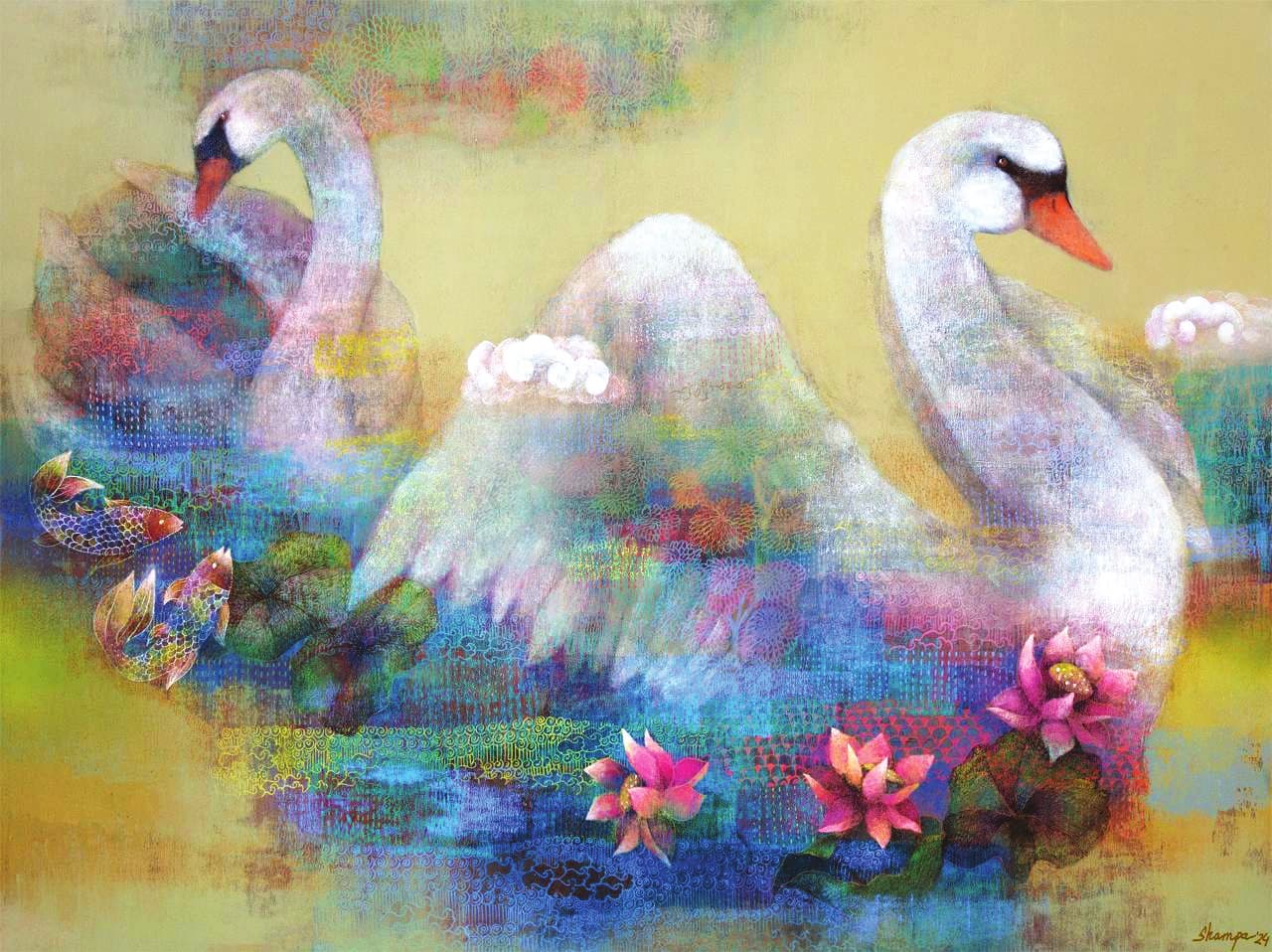
Shampa Sircar Das creates meditative paintings rooted in memory, silence, and Indian spiritual philosophy. Through luminous layers, dreamlike forms, and symbolic imagery, her works evoke stillness, introspection, and emotional depth, offering a contemplative vision of contemporary Indian art.
Art and philosophy intertwined
In the vast continuum of Indian art, creativity has never existed merely as visual expression; it has always been deeply intertwined with philosophy, spirituality, and the pursuit of higher consciousness. Rooted in the ideals of Satyam (truth), Shivam (the divine), and Sundaram (beauty), Indian aesthetics historically positioned art as a bridge between the material and the metaphysical.
“Across centuries, through temple architecture, sculpture, miniature painting, classical dance, and modern abstraction, artistic practice in India has remained inseparable from contemplation and inner inquiry.”
It is within this enduring philosophical lineage that the works of Shampa Sircar Das find their profound resonance. Her artistic journey reflects an intimate engagement with Indian philosophy and its continued relevance within contemporary visual culture. Rather than functioning as conventional images, her paintings emerge as meditative spaces, contemplative environments where rhythm, silence, memory, and emotional consciousness unfold gradually.
Flowing compositions, layered textures
Throughout Indian artistic history, philosophy has shaped both form and meaning. In Shampa Sircar Das's works, these philosophical undercurrents manifest through flowing compositions, layered textures, and intuitive spatial arrangements that echo the cyclical nature of existence and the cosmic rhythms celebrated in Indian thought. Much like the symbolic dance of Shiva Nataraja, where creation and dissolution exist simultaneously, her paintings embody movement, continuity, and transformation.
Her sensibility aligns closely with the concept of Advaita, or non-duality, where the distinction between self and universe begins to dissolve. Through abstraction, symbolism, and atmospheric layering, she constructs visual narratives that transcend direct interpretation. Her canvases do not seek to impose meaning; instead, they cultivate an experiential dialogue in which emotion, stillness, and transcendence coexist.
A visual world of dreamlike imagery
At first encounter, the viewer is drawn into luminous surfaces layered with translucent blues, muted ochres, diffused greens, and soft violets. Ethereal figures emerge and dissolve within dreamlike terrains where lotus flowers bloom across psychological landscapes, birds drift through silence, and animals move fluidly through human space. The imagery feels both intimate and archetypal, suspended somewhere between memory and myth.
“Ethereal figures emerge and dissolve within dreamlike terrains where lotus flowers bloom across psychological landscapes, birds drift through silence, and animals move fluidly through human space. The imagery feels both intimate and archetypal, suspended somewhere between memory and myth.”
Painting as meditation
But the emotional power of these works lies not only in their imagery; it resides equally in the extraordinary discipline of their construction. Das approaches painting as an act of meditation. Her canvases are built gradually through accumulations of pigment, texture, delicate markings, and repeated interventions that reveal themselves slowly over time. Fine ornamental structures, script-like gestures, and subtle surface patterns appear embedded within the paintings like fragments of memory or traces of an ancient visual language.
This layered process gives her paintings remarkable depth and material richness, qualities increasingly valued within contemporary collecting practices. Each work carries the presence of time within its surface. Nothing feels hurried or mechanically resolved. The paintings breathe through accumulation, erasure, and refinement, revealing new dimensions with prolonged viewing.
The female figure as metaphysical presence
The female figure recurs throughout her visual language, though never as conventional portraiture. These women function less as identifiable subjects and more as metaphysical presences, embodiments of intuition, silence, memory, and ecological interconnectedness. Forests move through bodies, clouds settle across skin, and animals inhabit human space with symbolic fluidity. The dissolution between the human and natural worlds reflects both Indian philosophical thought and an urgent contemporary ecological consciousness.
Colour as emotional atmosphere
Equally compelling is her command of colour and surface. Rather than relying on sharp contrast or decorative excess, Das allows colour to emerge through transparency and diffusion. Pigments appear suspended within the canvas, creating luminous atmospheres that feel almost weightless. Her chromatic restraint generates emotional quietude, a rare achievement in contemporary painting. The surfaces possess luminosity without theatricality, spirituality without ornamentation.
For collectors and institutions alike, the significance of Shampa Sircar Das lies in the clarity and consistency of her artistic language. In an international art market increasingly drawn toward authenticity, craftsmanship, and conceptual depth, her practice offers a mature and unmistakably individual visual vocabulary. Her works resist trends and instead cultivate timelessness, an essential quality for long-term collectability.
“These are not paintings that can be replicated quickly or produced in volume. Their layered execution, intricate detailing, and meditative construction demand patience, concentration, and prolonged engagement with the surface.”
Ultimately, what distinguishes Shampa Sircar Das is the emotional longevity of her work. Her paintings do not exhaust themselves through a single viewing; they deepen over time. They invite return, reflection, and renewed discovery. In an increasingly accelerated world, they offer something profoundly rare: stillness. In many ways, Shampa Sircar Das represents a significant voice within contemporary Indian art, one that successfully bridges spiritual inheritance with contemporary visual language.
For collectors, they offer far more than visual beauty. They offer permanence, introspection, and a deeply human experience of transcendence.