Ripe, Rare, Rarest
This year scarcity sharpens the Alphonso's mystique. Rimi Thapa on Konkan orchards, terroir, and why the prince of fruits demands patience.
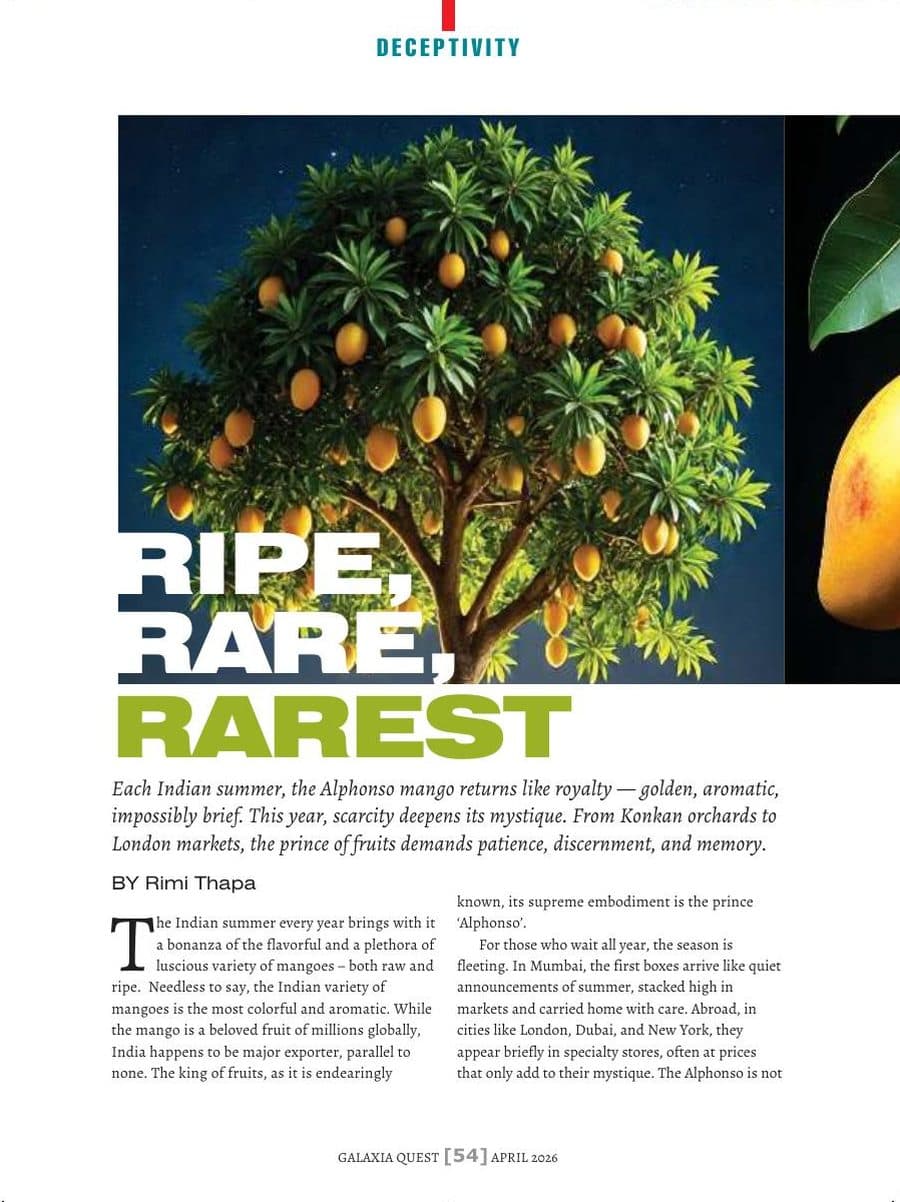
The Indian summer every year brings with it a bonanza of the flavourful and a plethora of luscious varieties of mangoes — both raw and ripe. Needless to say, the Indian variety of mangoes is the most colourful and aromatic. While the mango is a beloved fruit of millions globally, India is its major exporter, parallel to none. The king of fruits, as it is endearingly known, finds its supreme embodiment in the prince — Alphonso.
For those who wait all year, the season is fleeting. In Mumbai, the first boxes arrive like quiet announcements of summer, stacked high in markets and carried home with care. Abroad, in cities like London, Dubai, and New York, they appear briefly in specialty stores, often at prices that only add to their mystique. The Alphonso is not just a fruit; it is an experience, one tied deeply to memory, geography, and time. This year, however, that experience feels rarer.
Across the Indian state of Maharashtra's Konkan coast, the heartland of Alphonso cultivation, farmers are navigating an unusually difficult season. Unseasonal rains and shifting temperatures have disrupted the delicate flowering process, leading to significantly lower yields in regions such as Ratnagiri and Devgad. The mango trees, which already follow a natural cycle of high and low production every few years, seem particularly affected this time, their output reduced and their fruit more limited than usual.
“A season defined by scarcity sharpens desire — but also complicates authenticity.”
Not every mango that wears the Alphonso tag delivers the experience it promises.
The texture
A true Alphonso reveals itself slowly. Its skin carries a golden-yellow warmth, sometimes brushed with hints of red. Slice it open, and the flesh glows a deep, almost luminous orange. The texture is smooth, buttery, and entirely without fibre, while the aroma is sweet, floral, and intense — lingering long after the first bite.
Imitations can appear deceptively similar. Their colour may lean toward a paler yellow, their aroma less pronounced, their texture slightly fibrous. In a year when supply is tight and demand is unwavering, these differences matter more than ever.
For travellers and culinary explorers, this makes the pursuit of the perfect Alphonso all the more rewarding. To taste one in its place of origin — perhaps in a sun-dappled orchard in the Konkan, or at a bustling local market where vendors speak passionately of their produce — is to understand the idea of terroir in its most delicious form. The soil, the sea air, the climate all come together to create something that cannot quite be replicated elsewhere.
Kesar, quietly gaining ground
Even as the Alphonso retains its aura of exclusivity, the Kesar variety — cultivated in Gujarat and parts of western Maharashtra — offers a different expression of sweetness. Its saffron-hued pulp, slightly firmer texture, and longer shelf life make it both travel-friendly and versatile. In global markets, particularly where logistics and durability matter, Kesar is increasingly becoming the mango of choice.
Still, for many, the Alphonso remains unmatched — not just for how it tastes but for what it represents. It is a marker of seasonality in a world that often feels year-round, a reminder that some pleasures cannot be rushed or replicated.
This year, finding an authentic Alphonso may require a little more patience, a little more discernment. But perhaps that is part of its enduring appeal. After all, the finest journeys, like the finest mangoes, are rarely the easiest to find.