A New Visual Vocabulary
Engineer-turned-artist Tanvi Kulshreshtha is redefining contemporary Indian abstraction — creating immersive, tactile canvases where architecture, emotion and space meet, and where layered works don't decorate rooms but transform them.
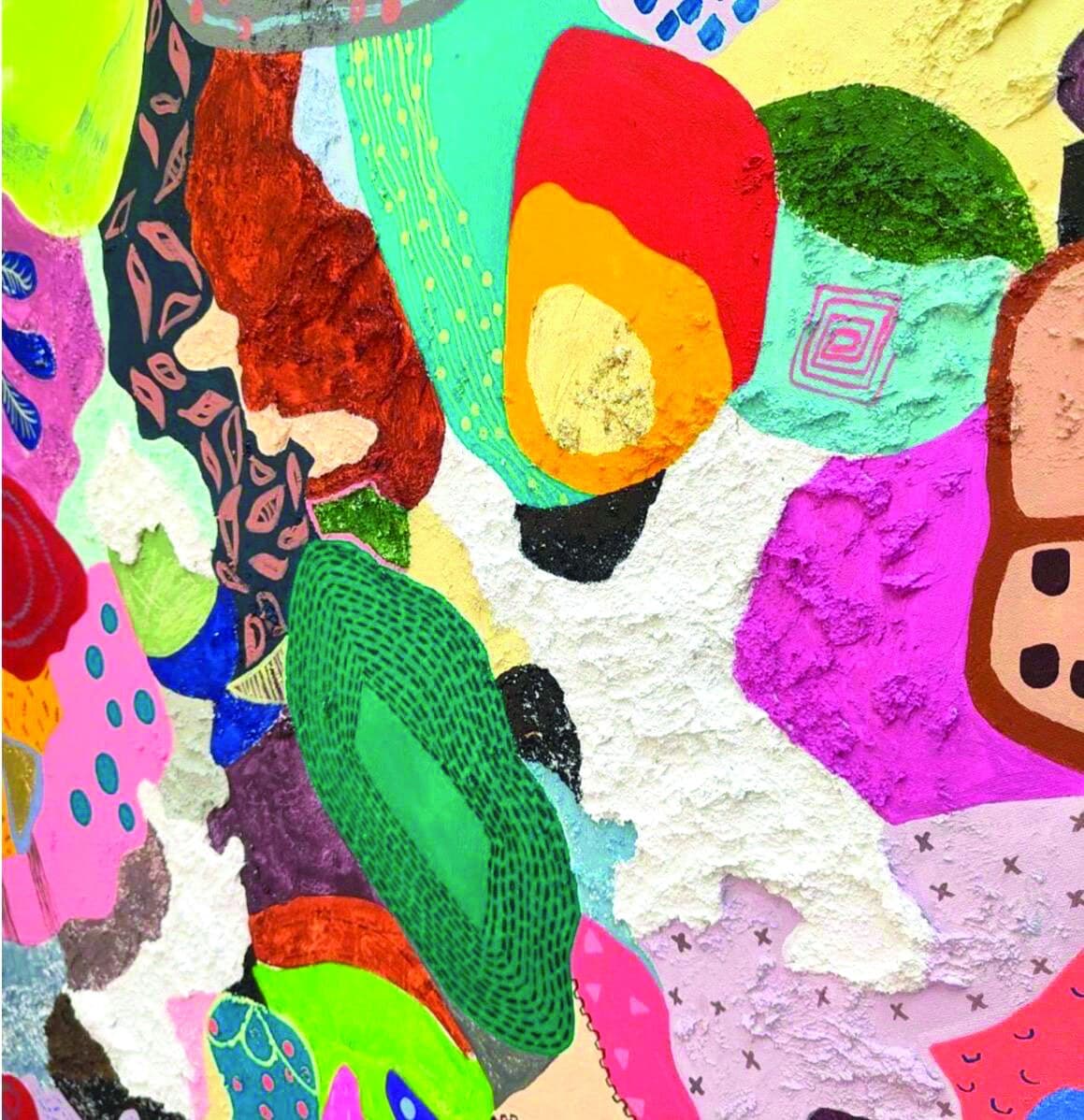
Tanvi Kulshreshtha is redefining Indian abstraction. An engineer-turned-artist, she creates immersive, tactile canvases where architecture, emotion, and space meet. Her layered works don't decorate rooms, they transform them, marking a confident new voice in contemporary Indian art.
There are moments in the evolution of an art market when an artist emerges whose practice signifies more than individual success. It signals the arrival of a new visual language. Tanvi Kulshreshtha belongs to this generation of contemporary Indian artists redefining abstraction; not as decoration, but as an immersive experience that engages architecture, emotion, and spatial perception.
An engineer and MBA by training, Kulshreshtha left Bengaluru's startup ecosystem to pursue a full-time artistic practice. That transition continues to inform her work. The precision of engineering underpins compositions that appear spontaneous, while her entrepreneurial mindset has enabled her to challenge conventional expectations of what contemporary abstraction can be within the Indian art market.
Entirely self-taught, she has developed a highly individual practice free from academic orthodoxy. Her studio is as much a laboratory as a workspace, where kitchen spatulas, dishwashing sponges, foam rollers, cardboard, and industrial tools become instruments for creating richly layered surfaces. These unconventional methods are not novelty; they are integral to an artistic language that is tactile, experimental, and deeply personal.
At first glance, Kulshreshtha's canvases appear intuitive, expanses of vibrant colour interrupted by gestural marks, textured passages, and fragmented forms. On closer viewing, however, their compositional discipline becomes evident. Negative space carries as much weight as painted form, while successive layers of pigment reveal traces of earlier decisions. The paintings feel less like surfaces that have been painted than landscapes that have gradually evolved.
Rather than narrating stories, her works create environments. They invite viewers to move through memory, emotion, geography, and personal experience without prescribing a single interpretation. This openness reflects the artist's belief that the emotional journey belongs to the viewer. The paintings succeed not because they explain themselves, but because they trust the audience to discover meaning within them.
“Texture in Kulshreshtha's work is never merely decorative; it is a language in itself. Thick impasto, mineral-like finishes, translucent washes, and luminous colour fields create paintings that demand physical presence.”
Materiality is central to this experience. Texture in Kulshreshtha's work is never merely decorative; it is a language in itself. Thick impasto, mineral-like finishes, translucent washes, and luminous colour fields create paintings that demand physical presence. From a distance they command architectural space; viewed closely they reveal intricate micro-landscapes of experimentation and process. It is this continual dialogue between control and spontaneity that defines her practice.
While Kulshreshtha acknowledges the influence of artists such as Vasudeo Gaitonde, Jackson Pollock, Yayoi Kusama, and Frank Stella, these references function as philosophical touchstones rather than stylistic templates. Her work retains a distinctly individual identity, shaped by an unmistakable Indian sensibility expressed through rhythm, chromatic confidence, layered complexity, and spatial intuition rather than overt symbolism.
Her visual vocabulary has also been shaped by place. Growing up on a university campus surrounded by murals, frescoes, and sculpture fostered an early engagement with art, while living in Rajasthan, Bengaluru, and Pune expanded her understanding of colour, form, and atmosphere. An avid traveller, expanded her artistic horizon and has further enriched her practice. Rather than depicting these places literally, she absorbs their emotional and architectural character, translating experience into abstraction.
This openness to experimentation is matched by a refusal to repeat herself. Each body of work becomes an opportunity to rethink technique, material, and composition while maintaining an unwavering commitment to craftsmanship. For Kulshreshtha, originality is not a stylistic choice but an artistic responsibility.
That philosophy has naturally led her beyond the gallery. Her paintings increasingly function as architectural interventions rather than decorative objects, resulting in collaborations with leading design practices including Neterwala & Aibara, Sanjay Puri Architects, Studio Osmosis, Design Hex, ACKM Studio, and Ali Baldiwala.
From an interior designer's perspective, Kulshreshtha's work possesses a rare architectural intelligence. Her paintings anchor a space without overwhelming it, introducing movement, depth, and identity while allowing the surrounding environment to breathe. Whether placed in luxury residences, hospitality projects, corporate environments, or cultural institutions, the works transform the spatial experience. The room begins to converse with the artwork rather than simply containing it.
“Kulshreshtha's abstractions reward slow looking. Their layered complexity reveals new relationships with every encounter, allowing the paintings to evolve alongside their owners.”
Collectors are responding to the same qualities. Today's art buyers increasingly seek works that sustain engagement over time rather than offering immediate visual gratification. Kulshreshtha's abstractions reward slow looking. Their layered complexity reveals new relationships with every encounter, allowing the paintings to evolve alongside their owners. They become deeply personal works that retain both emotional resonance and formal integrity.
Her significance, however, extends beyond individual collectors. Kulshreshtha represents a broader shift within the Indian art market. While collecting has long centered around established modernists, a younger generation of globally aware, design-conscious collectors is creating new demand for contemporary abstraction. Her work speaks directly to this audience, offering paintings that are intellectually rigorous yet emotionally accessible, equally at home in private collections, architectural spaces, and institutional settings.
In doing so, she is helping expand not only the audience for contemporary abstraction but also the confidence with which it is collected. This is how art markets evolve, not simply through the production of new work, but through the creation of new ways of seeing and collecting.
Recognition from publications such as Architectural Digest, Filmfare, India Today Home, and Good Homes and installation at the Encalm Lounge, Terminal 3, Delhi International Airport, Kulshreshtha has established herself as a significant voice in contemporary Indian abstraction. She reflects the growing visibility of her practice beyond conventional gallery circuits. Collectors frequently speak of recognising fragments of their own emotional landscape within her paintings, a testament to the openness and universality of her visual language.
“For Kulshreshtha, painting is not simply a profession but an instinctive necessity. Inspired as readily by molecular gastronomy, the meditative cadence of the Vishnu Sahasranamam, or John Lennon's Imagine, her practice remains grounded in curiosity, observation.”
For Kulshreshtha, painting is not simply a profession but an instinctive necessity. Inspired as readily by molecular gastronomy, the meditative cadence of the Vishnu Sahasranamam, or John Lennon's Imagine, her practice remains grounded in curiosity, observation, and an enduring desire to experiment.
Looking ahead, her ambitions naturally extend towards museum-scale installations, major architectural commissions, and international collaborations. Her objective is not simply to participate in the global discourse on abstraction, but to contribute a distinctly contemporary Indian voice that is both confident and original.
As India's collector community continues to mature and the dialogue between art and architecture grows increasingly sophisticated, artists like Tanvi Kulshreshtha are helping define the future of contemporary Indian art. Not by following global trends, but by creating a visual language that is unmistakably their own.